
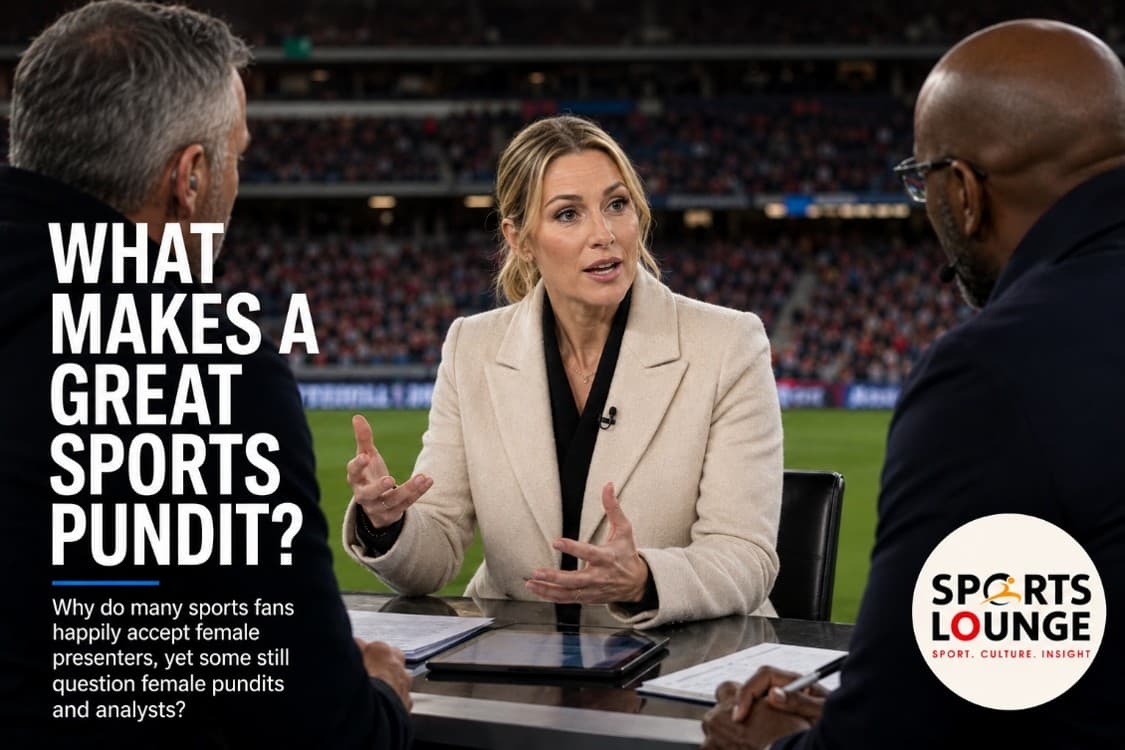
Few subjects in modern sports broadcasting generate as much discussion as the role of female pundits covering men's sport.
It is a debate that surfaces regularly on social media, radio phone-ins and in newspaper columns. Sometimes the discussion is thoughtful. At other times it quickly becomes polarised. Yet beneath the noise lies a genuinely interesting question that extends beyond gender.
What actually makes a great sports pundit?
The question matters because sports broadcasting has changed dramatically over the past thirty years.
There was a time when television coverage followed a fairly predictable formula. A presenter introduced the programme, former players discussed the action and viewers consumed the analysis. The structure was familiar and largely unchallenged.
Today, audiences have more choice than ever before. Matches are analysed by former players, managers, coaches, journalists, statisticians and specialist broadcasters. Podcasts, streaming platforms and social media have expanded the number of voices involved in sporting discussion.
As a result, the definition of expertise has become less straightforward.
Most supporters have little difficulty separating the role of presenter from that of pundit.
Presenters are responsible for guiding programmes, conducting interviews and managing discussions. Their success depends largely on broadcasting skills rather than sporting achievement. Few viewers question whether someone such as Gabby Logan or Kelly Cates possesses the skills required to host a major sporting programme.
The debate tends to emerge when analysis begins.
For some supporters, particularly those who grew up watching former players dominate television coverage, elite playing experience remains the gold standard. The argument is relatively simple. If someone has performed at the highest level, they possess insights unavailable to those who have not.
There is certainly logic in that position.
Former professionals can often explain pressure, decision-making and dressing-room dynamics in ways that resonate with audiences. They have experienced situations that most supporters can only imagine. Their knowledge is rooted in direct participation.
Much of sports broadcasting has been built upon this principle.
Yet the argument becomes more complicated when examined closely.
Elite playing experience has never been the only route into respected sports analysis. Some of the most influential voices in modern sport were not world-class players. Across football, rugby, cricket and American sport, numerous journalists, coaches and analysts have built reputations through study, observation and communication rather than elite playing careers.
The modern game itself has evolved.
Football clubs now employ analysts, performance specialists, recruitment experts and tactical researchers. Many never played professionally, yet their expertise is highly valued by managers and players operating at the highest level of the sport.
Knowledge has become increasingly specialised.
This reality sits at the heart of the debate surrounding female pundits.
Critics sometimes argue that women who have not played men's professional football cannot fully understand the men's game. Supporters of female punditry counter that football knowledge is not determined solely by gender or by participation in one specific competition.
Both perspectives contain elements worth examining.
Former players such as Alex Scott and Karen Carney built distinguished careers within women's football before moving into broadcasting. Their supporters point to years of professional experience, coaching knowledge and detailed understanding of the sport.
Critics often respond by questioning whether experience gained in the women's game automatically translates to analysis of the men's game.
The discussion is not entirely new.
Throughout sporting history, broadcasters have frequently faced questions about credibility and expertise. Former players have been criticised for lacking communication skills. Journalists have been criticised for never having played professionally. Coaches have been accused of overcomplicating analysis. Every generation seems to debate who is qualified to speak about sport.
Perhaps the more interesting question is what audiences actually want.
Some viewers seek technical insight. They want tactical explanations and strategic analysis. Others value storytelling, personality and the ability to communicate complex ideas clearly. Some enjoy hearing experiences from former players. Others prefer objective analysis that is less influenced by personal relationships within the game.
A great pundit may possess several of these qualities.
Few possess all of them.
The rise of social media has added another layer to the discussion. Broadcasters today operate in an environment where criticism is immediate and often amplified. Male pundits receive criticism. Female pundits receive criticism. Yet numerous studies examining online abuse have found that women working in sports broadcasting are often subjected to a disproportionate volume of personal and gender-related attacks compared with their male counterparts.
That reality makes sensible discussion more difficult.
Legitimate debate about broadcasting standards can quickly become entangled with issues of prejudice and abuse.
The result is that people often end up arguing about different things entirely.
For Sports Lounge readers, there is perhaps a broader issue worth considering.
Sport has always evolved. The games themselves change. Media changes. Audiences change. Broadcasting changes. The voices explaining sport inevitably change as well.
The challenge is not deciding whether every pundit should come from the same background.
The challenge is identifying what qualities genuinely improve understanding.
Can they explain the game?
Can they offer insight?
Can they communicate clearly?
Can they make viewers think differently about what they have just watched?
Those questions seem more useful than focusing solely on who is speaking.
After all, supporters rarely remember a pundit's playing record when they are listening to a compelling piece of analysis. They remember whether the explanation helped them understand the sport better.
Perhaps that is ultimately the answer.
The most effective sports pundits are not defined by gender, age or even playing history alone. They are defined by their ability to add value to the conversation.
Some achieve that through elite playing experience.
Others achieve it through coaching knowledge.
Others through years of study, observation and communication.
The route may differ.
The objective remains the same.
To help supporters understand and appreciate sport a little more deeply.
And in the end, that is surely what good punditry is supposed to do.
Majid Lavji
Founder & Editor
Majid Lavji is the Founder and Editor of Sports Lounge. With more than 30 years of experience across sport, media and business, he is passionate about telling the stories behind the games we love. Through Sports Lounge, he aims to provide intelligent, engaging sports journalism that values insight, history and context as much as results and headlines.