
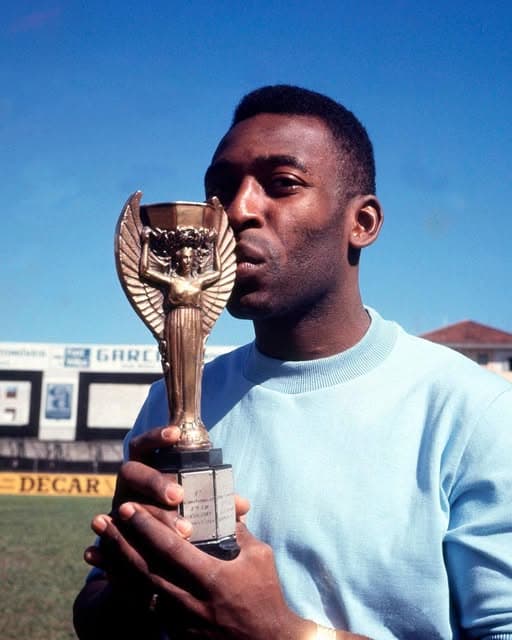
Every sport has a figure who transcends the game.
Cricket had Sir Donald Bradman. Boxing had Muhammad Ali. Golf had Jack Nicklaus before Tiger Woods arrived. Their achievements stretched beyond statistics and trophies. They became symbols of their sport, recognised even by people who never watched them compete.
Football had Pelé.
Ask supporters of a certain generation to name the greatest footballer they ever saw and many will still answer without hesitation. Younger fans may point to Lionel Messi or Cristiano Ronaldo. Others will champion Diego Maradona, Johan Cruyff or Zinedine Zidane.
Yet for much of the twentieth century, there was no debate.
There was simply Pelé.
Born Edson Arantes do Nascimento in 1940 in the Brazilian town of Três Corações, his journey began far from the glamour and wealth associated with modern football. The son of a footballer, he grew up in modest circumstances, often playing with improvised balls because proper equipment was difficult to afford.
Like so many great sporting stories, his rise appears almost unbelievable in hindsight.
At just 17 years of age, Pelé travelled with Brazil to the 1958 World Cup in Sweden. The tournament would change football forever.
Brazil had never won the World Cup. European teams were widely expected to dominate. Pelé entered the competition as a gifted teenager largely unknown outside South America.
He left it as a global star.
His performances during the knockout stages remain among the most extraordinary breakthroughs the sport has witnessed. He scored a hat-trick in the semi-final against France before producing two goals in the final against Sweden as Brazil secured its first World Cup triumph.
One of those goals remains iconic. Controlling the ball, flicking it over a defender's head and volleying into the net, the teenager displayed a confidence and imagination that seemed to belong to another era.
Football had discovered its first global superstar.
Yet remarkably, his greatest achievements were still ahead.
The 1962 World Cup in Chile brought another winners' medal, although injury restricted his involvement during the tournament. By the time Mexico hosted the competition in 1970, Pelé had become the most famous footballer on the planet.
For many supporters, that tournament remains the defining image of both Pelé and Brazil.
The 1970 Brazilian side is frequently described as the greatest international team ever assembled. It contained extraordinary talents including Jairzinho, Tostão, Rivelino and Carlos Alberto. Yet even among such company, Pelé remained the focal point.
The final against Italy is often remembered as one of football's greatest showcases. Brazil won 4-1, playing a style of football that appeared joyful, creative and expressive. Pelé scored the opening goal and helped orchestrate one of the most celebrated team performances in World Cup history.
When the final whistle sounded, he became the first and remains the only player to win three World Cups.
That achievement alone would have secured his place in football history.
Yet Pelé's significance extends beyond medals and goals.
It is difficult for modern supporters to fully appreciate the impact he had on the global growth of football. Today, elite players perform weekly before worldwide audiences. Every goal is shared instantly. Every match is available somewhere on television.
Football in the 1950s and 1960s was different.
International coverage was limited. Information travelled slowly. Most supporters only encountered foreign players occasionally.
Pelé changed that.
His brilliance became a story that crossed borders, languages and cultures. Whether people followed football or not, they knew his name. He became one of the first truly global sporting celebrities.
In many ways, he helped prepare football for the modern era.
His influence was particularly significant in countries where football was still developing. For countless young players across Africa, Asia and North America, Pelé became proof that football belonged to everyone. He represented possibility.
The image of a young black footballer from Brazil becoming the most famous athlete in the world carried enormous cultural significance.
His club career reflected a different era.
Unlike many modern stars, Pelé spent the majority of his career with Santos in Brazil. At a time when Europe's wealthiest clubs sought his signature, he remained largely loyal to the club that developed him. Together they travelled the world, attracting crowds wherever they played.
Supporters did not simply attend matches to watch Santos.
They attended to watch Pelé.
When he eventually moved to the United States to play for the New York Cosmos in 1975, his arrival helped transform the profile of football in North America. The sport remained relatively minor compared to baseball, American football and basketball, but Pelé's presence generated unprecedented attention.
Many believe his influence helped lay foundations for football's later growth across the United States.
It is one of the reasons the World Cup's return to North America in 2026 feels particularly fitting.
Pelé was one of the first footballers to understand that the game's future would be global.
Of course, every generation debates greatness.
Supporters compare statistics, trophies and eras. Modern football's physical demands are different. The game itself has evolved. Comparisons between generations are rarely straightforward.
Yet perhaps Pelé's true legacy lies beyond such arguments.
He arrived at a moment when football was becoming the world's game and helped accelerate that transformation. He gave millions of people a reason to fall in love with the sport.
More importantly, he played with a joy that remains evident decades later.
Watch old footage of Pelé and something immediately stands out.
The smile.
The creativity.
The sense that football, despite the pressure and expectation, remained something to be enjoyed.
That spirit helped define Brazil's relationship with the game and shaped how much of the world came to view football itself.
When Pelé passed away in 2022, tributes arrived from every corner of the globe. World leaders, athletes, clubs and supporters paid their respects. It felt less like the passing of a former footballer and more like the loss of a cultural figure whose influence stretched far beyond sport.
Few athletes leave that kind of legacy.
As the World Cup prepares for another chapter in 2026, new stars will emerge. New heroes will be created. Fresh memories will be written into football history.
Yet every World Cup still carries something of Pelé within it.
Because before football became a global industry, before it became the world's most popular sport, there was a young Brazilian who showed the world what was possible.
And in doing so, he helped make football the game we know today.
Related Articles
World Cup 2026: The Biggest Tournament Football Has Ever Seen
The Weekly Sports Read
Subscribe to The Weekly Sports Read for thoughtful features, interviews and analysis from across the world of sport.
Majid Lavji
Founder & Editor
Majid Lavji is the Founder and Editor of Sports Lounge. With more than 30 years of experience across sport, media and business, he is passionate about telling the stories behind the games we love. Through Sports Lounge, he aims to provide intelligent, engaging sports journalism that values insight, history and context as much as results and headlines.