
World Cup Stories · Part 1 of 3 — Hungary, 1954
Football history tends to remember winners. Their names are engraved on trophies, their photographs fill museums and their achievements are passed from one generation to the next. Occasionally, however, a team loses the match that matters most and still earns a place among the immortals.
Hungary's side of the early 1950s belongs firmly in that category.
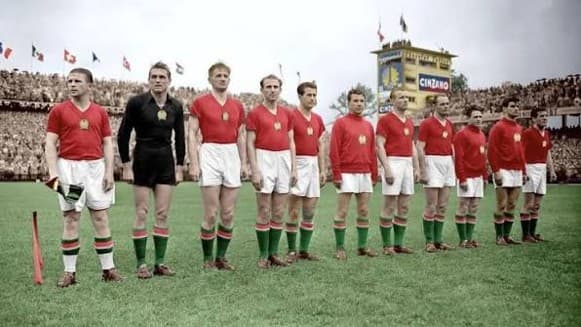
Known as the Golden Team, the Mighty Magyars or simply the Magical Magyars, Hungary approached the 1954 World Cup having transformed international football. They were Olympic champions, had gone more than four years without defeat and possessed a collection of players whose movement and intelligence seemed years ahead of their opponents.
Ferenc Puskás was the captain and the most celebrated name, but this was not a one-man side. Sándor Kocsis was an exceptional goalscorer and one of the finest headers of a ball the game had seen. József Bozsik controlled midfield with authority, while Nándor Hidegkuti changed conventional ideas about how a centre-forward should play. Behind them stood goalkeeper Gyula Grosics, later known as the Black Panther, whose willingness to operate beyond his penalty area anticipated the modern sweeper-keeper.
Together, they created a style of football that unsettled almost everything defenders had been taught.
At the time, most teams still arranged themselves in fairly rigid positions. Centre-forwards occupied central defenders, wingers remained wide and tactical responsibilities were easier to identify. Hungary introduced far greater movement. Hidegkuti regularly dropped into midfield, drawing defenders away from their positions and creating spaces for Puskás, Kocsis and the wide players to attack.
To a modern audience, none of this sounds especially revolutionary. False nines, rotating forwards and defenders stepping into midfield are now familiar features of elite football. In the early 1950s, however, Hungary's movement looked almost bewildering.
England discovered this at Wembley in November 1953.
Before that afternoon, England had never lost a home international against a team from outside the British Isles. There remained a deep confidence within the English game that the country which had codified football still understood it better than anyone else.
Hungary won 6–3.
The scoreline was striking, but the manner of the defeat caused the greater shock. England were not simply beaten by a more talented side. They were tactically dismantled. Hidegkuti scored a hat-trick, Puskás produced moments of breathtaking skill and Hungary's passing repeatedly pulled the English defence apart.
The match became known as the Game of the Century, although for England it felt more like a public lesson in how far the game had moved on.
Six months later, the teams met again in Budapest. Anyone hoping the Wembley result had been an accident was quickly disabused. Hungary won 7–1, which remains England's heaviest international defeat.
By the summer of 1954, the World Cup appeared to be Hungary's tournament to lose.
They arrived in Switzerland with a formidable record and immediately justified their status as favourites. South Korea were beaten 9–0 in their opening match. West Germany were then defeated 8–3, although Puskás suffered an ankle injury during the game that would later cast a shadow over the tournament.
Hungary's route through the knockout stages was considerably more demanding. They defeated Brazil 4–2 in a fierce quarter-final remembered as the Battle of Bern, a match that descended into violence and ended with three players being sent off. In the semi-final, Hungary faced reigning world champions Uruguay and won 4–2 after extra time, with Kocsis scoring twice in the additional period.
By then, they had overcome the holders and one of South America's strongest teams. The final brought a rematch against West Germany, the side Hungary had beaten by five goals during the group stage.
Everything appeared to point towards a Hungarian coronation.
Yet football rarely respects the expected script.
The final was played at Bern's Wankdorf Stadium on 4 July 1954 in heavy rain. Puskás returned to the team, although he was not fully fit after his ankle injury. Even so, Hungary began with the assurance of champions. Puskás scored after six minutes and Zoltán Czibor added another two minutes later.
After eight minutes, Hungary led 2–0.
Given their form, reputation and earlier victory over the same opposition, the contest appeared to be moving towards the inevitable. Instead, West Germany responded almost immediately. Max Morlock reduced the deficit in the tenth minute and Helmut Rahn equalised eight minutes later.
The match settled into a far more even contest than most had anticipated. Hungary created chances and repeatedly tested goalkeeper Toni Turek, but the winner would not come. With six minutes remaining, Rahn scored again to put West Germany ahead.
Puskás then placed the ball in the net late in the game, only for the goal to be ruled out for offside. West Germany held on to win 3–2 and claim its first World Cup.
In Germany, the result became known as the Miracle of Bern. It offered a country still recovering from the devastation of the Second World War a rare moment of national celebration and became one of the most significant events in German sporting history.
For Hungary, it was a national trauma.
The players returned home having lost only once in more than four years, but it was the one defeat that defined the tournament. A side that had beaten nearly everyone, won Olympic gold and revolutionised the game had failed to win football's greatest prize.
That is the cruelty of knockout sport. Years of excellence can be reduced to one wet afternoon, one deflection, one disputed decision or one opponent producing the match of its life.
Yet judging Hungary solely by the final would miss the importance of what they achieved.
The Golden Team altered the way football was understood. Their positional movement helped challenge the rigid systems of the period. Their use of Hidegkuti as a withdrawn centre-forward influenced coaches across Europe. Their quick passing, technical confidence and willingness to exchange positions pointed towards the more fluid football that would later become associated with the Netherlands, Ajax, Barcelona and many of the finest modern teams.
Their influence was not confined to tactics. Hungary demonstrated that international football could be played with imagination and intelligence without sacrificing power or efficiency. They were capable of overwhelming opponents with goals, but their football was built on more than attacking instinct. It was organised, rehearsed and tactically sophisticated.
The political history surrounding the team adds another layer to its story.
Hungary was governed by a communist regime, and the national side became an important symbol of state prestige. Several leading players represented Honvéd, the army club, and Puskás held the rank of major, which gave rise to his famous nickname, the Galloping Major.
In 1956, the Hungarian Uprising was crushed by Soviet forces. A number of the Golden Team's leading figures subsequently left the country. Puskás eventually joined Real Madrid, where he built a second extraordinary career and became one of the defining players of European club football.
The team that might have remained together for years was scattered.
Hungary would continue to produce excellent players and strong national sides, but it never again reached quite the same level of international influence. The defeat in Bern therefore came to represent more than a lost final. It marked the ending of an era that political events would soon make impossible to recreate.
Arguments about the greatest team never to win the World Cup will always be subjective. The Netherlands of 1974 changed how people thought about space and movement. Brazil's 1982 side played with a beauty that remains deeply loved. Other generations will put forward France in 1982 or perhaps more recent teams whose talent went unrewarded.
Hungary's claim, however, remains unusually powerful.
They did not simply play attractive football. They dominated the international game for several years, won the Olympics, defeated England twice in historic fashion and reached the World Cup final having already beaten the eventual champions 8–3.
They were not a romantic side whose reputation grew mainly through nostalgia. They were, by every meaningful measure, an outstanding team.
Their tragedy was that the World Cup is not awarded for sustained excellence, innovation or influence. It is awarded to the team that wins the final.
West Germany deserved its victory in Bern. They recovered from two goals down, adapted to the conditions and produced one of the great upsets in sporting history. Acknowledging Hungary's greatness should not diminish what the Germans achieved.
It should instead remind us that football history is more complicated than a list of winners.
Some champions are remembered because they lifted the trophy. Other teams are remembered because they changed the game.
Hungary did not leave Switzerland with the World Cup in 1954, but more than seventy years later, coaches, historians and supporters still discuss the patterns of play, the movement of Hidegkuti, the goals of Kocsis and the genius of Puskás.
The defeat denied them football's greatest prize. It did not deny them greatness.
That is why the Mighty Magyars remain, for many, the greatest team never to win the World Cup.
Majid Lavji
Founder & Editor
Majid Lavji is the Founder and Editor of Sports Lounge. With more than 30 years of experience across sport, media and business, he is passionate about telling the stories behind the games we love. Through Sports Lounge, he aims to provide intelligent, engaging sports journalism that values insight, history and context as much as results and headlines.