
A football result is important for a few days. A great sporting story can last a lifetime.
One of my earliest memories of sport is not a match.
It is a conversation.
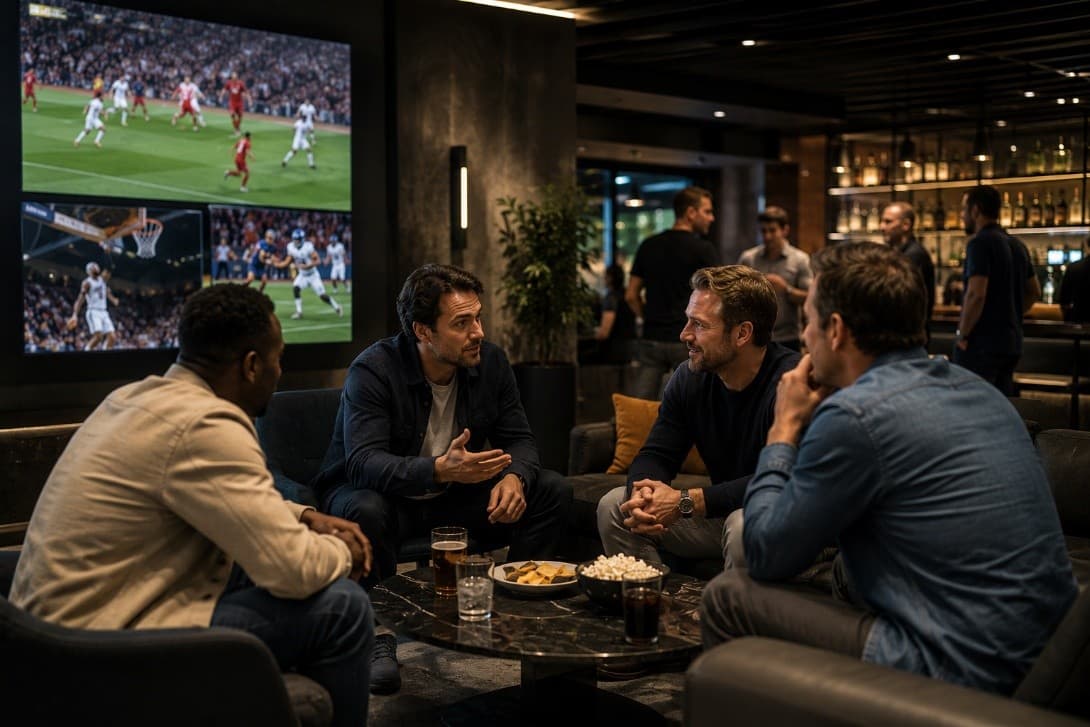
A group of men standing in a pub discussing football. No shouting. No outrage. No desperate need to win the argument. Just people exchanging opinions, sharing stories and remembering moments that mattered to them.
One supported Liverpool. Another followed Everton. A third preferred cricket and seemed capable of recalling scorecards from twenty years earlier. Somebody would mention a player from the 1970s and suddenly the conversation would move in a completely different direction.
Nobody was in a hurry.
Nobody was looking at a phone.
Nobody was trying to go viral.
They were simply talking about sport.
Looking back, it strikes me that many of my favourite sporting memories have nothing to do with watching matches. They involve conversations afterwards. The discussions in the pub, the debates at work on Monday morning, the stories shared between generations and the disagreements that somehow ended with everyone ordering another drink.
Sport was often the starting point rather than the destination.
The conversation mattered as much as the result.
Somewhere along the way, we seem to have lost a little of that.
Modern sport has never been more accessible. We can watch matches from every corner of the world. Statistics are available instantly. Every goal, try, wicket and touchdown can be viewed within seconds of it happening. Fans have access to more information than any previous generation could have imagined.
Yet for all this access, meaningful sporting conversation sometimes feels harder to find.
Too much modern discussion has become performative.
Television panels are often designed around disagreement because disagreement creates attention. Social media rewards certainty rather than nuance. The loudest voices frequently receive the most engagement, regardless of whether they have anything particularly insightful to say.
Everything becomes a debate.
Everything becomes an argument.
Everything becomes immediate.
Football managers are either geniuses or frauds. Players are either world-class or finished. Teams are either destined for greatness or facing crisis.
There seems little room left for patience.
Or perspective.
Or reflection.
Yet sport has always been richer than that.
The greatest sporting stories rarely reveal themselves immediately. Their significance often becomes clearer with time. Ask football supporters about the greatest teams they have watched and many will talk about how those teams evolved over several seasons. Ask cricket followers about memorable Ashes series and the conversation often drifts into stories about atmosphere, personalities and moments rather than statistics.
Sport rewards memory.
It rewards context.
It rewards discussion.
The older I become, the more I realise that some of the most enjoyable sporting conversations are not about who won.
They are about why something mattered.
Why did a particular player capture the imagination? Why does one sporting rivalry endure while another fades away? Why do some athletes become cultural figures while others remain merely successful competitors?
These are the conversations that stay with people.
A football result is important for a few days. A great sporting story can last a lifetime.
Perhaps this is why older supporters often approach sport differently.
Many have seen enough seasons to understand that success and failure are temporary. They have watched dominant teams decline and struggling clubs recover. They have witnessed tactical revolutions, rule changes and generations of athletes come and go.
Experience encourages perspective.
The conversation becomes less about reaction and more about understanding.
That does not mean passion disappears.
Far from it.
The best sporting conversations are passionate.
But they are also thoughtful.
They allow room for disagreement without hostility. They recognise that intelligent people can watch the same match and arrive at different conclusions. They acknowledge that sport is often too complex to fit neatly into a headline or social media post.
In many ways, sport mirrors life.
The older we get, the more we appreciate complexity.
A young supporter might ask whether a player was better than another. An older supporter may be more interested in discussing the different eras, circumstances and challenges they faced.
Neither approach is wrong.
But one tends to produce more interesting conversations.
This matters because sport has always been one of society's great meeting places.
Long before podcasts, YouTube channels and social media platforms, people gathered to talk about matches. The discussions crossed generations, professions and backgrounds. Sport created common ground between people who might otherwise have had little to say to one another.
That remains one of its greatest strengths.
At a time when many aspects of modern life seem increasingly fragmented, sport still has the ability to bring people together.
The challenge is ensuring we do not lose the quality of those conversations.
There is a difference between consuming sport and reflecting on it.
There is a difference between reacting and understanding.
There is a difference between noise and conversation.
Perhaps that is why reading still matters.
A well-written article asks something different of the reader. It encourages thought rather than reaction. It allows ideas to develop. It respects the audience's intelligence and rewards their attention.
The same can be said of good conversation.
Neither needs to be rushed.
Neither needs to produce a winner.
Both are richer when people take time to listen.
That belief sits at the heart of Sports Lounge.
There are countless places to find breaking news, transfer rumours and instant reaction. Those things have their place.
But there should also be room for something slower.
Something more reflective.
A place where sport can be discussed rather than shouted about.
A place where stories matter as much as statistics.
A place where readers are treated as participants in a conversation rather than consumers of content.
Because sport deserves that.
And perhaps, in an age where everyone seems to be talking at each other, the simple act of having a thoughtful conversation has become more valuable than ever.
Majid Lavji
Founder & Editor
Majid Lavji is the Founder and Editor of Sports Lounge. With more than 30 years of experience across sport, media and business, he is passionate about telling the stories behind the games we love. Through Sports Lounge, he aims to provide intelligent, engaging sports journalism that values insight, history and context as much as results and headlines.